
Inventory and capitalProduce too much,
Produce too much,
and capital sits in stock.
Extra production brings storage, logistics and manufacturing costs. Clear demand calculations give you a basis for adjustments.

HPSS Production Scheduling System
Check demand, materials and equipment together.
Give every production plan a clear basis.

HPSS / SCHEDULING CHALLENGES
Scheduling shapes more than production order.
It affects stock, delivery and team coordination.
Extra production brings storage, logistics and manufacturing costs. Clear demand calculations give you a basis for adjustments.

Materials, equipment and available operating time all have limits. Seeing bottlenecks helps identify plans that need coordination.

Added or revised orders affect more than one spreadsheet. Production and material requirements both need another check.
HPSS / HOW IT HELPS
Let the system handle repeated calculations.
Keep operational judgment with your planners.
Reassess demand when orders changeRecalculate after demand changes
HPSS supports recalculation after demand changes, combining inventory and existing schedule information to help planners understand the remaining demand to schedule.
Reduce repeated manual checks and give adjustments a clear basis.
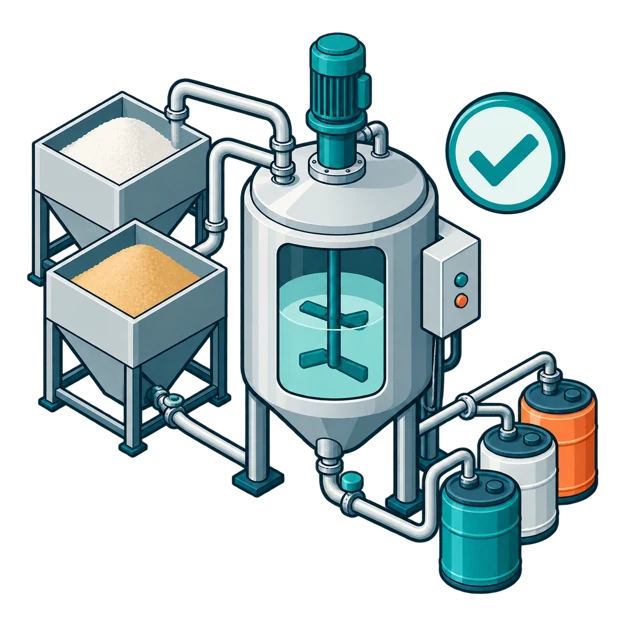 Bring operating conditions into scheduling decisions
Materials, equipment, batch sizes and times
Include available materials, equipment routes, minimum and maximum batch sizes, and setup, production and cleaning times in calculations to help develop feasible plans.
See which requirements can be scheduled and which still need attention.
 Coordinate the next step with a shared plan
Production proposals, procurement proposals and inventory estimates
Organize planning results into production proposals, material procurement proposals and product inventory estimates, giving production and procurement a shared planning basis.
Reduce information gaps and clarify handoffs.
These illustrations explain the workflow. Scheduling results depend on input data and operating constraints. Procurement proposals require subsequent purchasing procedures, and inventory estimates must be checked against actual conditions.
HPSS / FROM DATA TO CONFIRMED PLANS
Draft schedules are reviewed and adjusted,
then formally confirmed by a designated planner.
Import Excel files and validate demand, inventory, formulations and process data.
Establish a calculation basisCalculate net requirements and draft schedules based on material, equipment, batch size and time constraints.
Develop feasible plansReview constraints and adjust plans. Recalculate and confirm when changes are needed.
Retain human decisionsAfter formal confirmation, use planning results to prepare production and material procurement proposals.
Support team coordination
HPSS helps make demand and constraints visible. Planners who understand the operation provide final confirmation.
DEPLOYMENT / ON YOUR LOCAL NETWORK
HPSS comes installed on a dedicated server.
Departments access their workspace through a browser.
Scheduling calculations, the application and the database run on the server. Role-based responsibilities provide a clear division of daily operation and maintenance.
Browser access with role-based responsibilities
Configuration assessed for your needs
Integrated software and data environment
Review data and operating procedures
Service scope defined in your agreement
Server specifications, licensing, implementation training and maintenance services are subject to the quotation and delivery agreement.
GOOD TO KNOW
Clarify your needs first,
then choose an appropriate implementation.
HPSS is designed for manufacturers that need to manage production schedules, material requirements and equipment usage. Representative requirements involving batches, formulations, equipment routes and cleaning times can be reviewed during a demo to assess fit.
HPSS supports Excel import and data validation. Implementation includes reviewing formats, master data, inventory, formulations and processes to check completeness and field mapping.
The system assists with calculations and draft schedules. A designated planner reviews, adjusts and formally confirms them. Material, equipment, batch size and time constraints mean that not every requirement can necessarily be scheduled.
HPSS runs on a dedicated server and users access it through a browser on the company network. Network requirements, accounts, supported environments and deployment conditions are confirmed during implementation.
HPSS exports material procurement proposals for purchasing staff to review and process. Proposals do not execute purchases directly. Product inventory estimates must also be checked against actual purchasing, receipts and operating conditions.
We first review production needs, equipment conditions, current data and user roles, then confirm the server, licensing, data preparation, training and maintenance scope. Deliverables and fees are defined in the quotation.
REQUEST AN HPSS DEMO
Start with the scheduling problem you most want to solve,
and explore an appropriate approach together.
Email links open your email application.